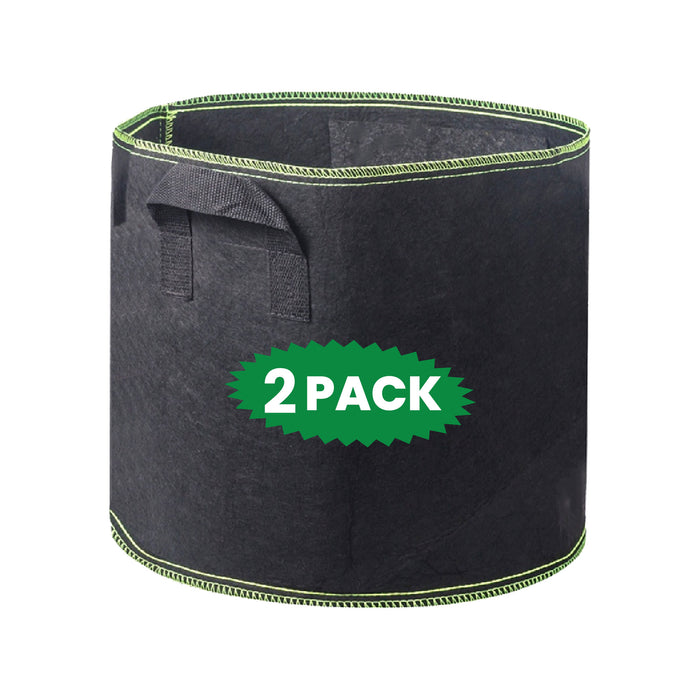
where to buy grow bags for plants 2 Pack Plant Grow Bags Heavy Duty Thickened Nonwoven Black Plant Fabric  Pots Reinforced Handles
SKU: 68453108564
where to buy grow bags for plants

where to buy grow bags for plants 2 Pack Plant Grow Bags Heavy Duty Thickened Nonwoven Black Plant Fabric Pots Reinforced Handles

Sale price$22.91 Regular price$25.45
Save 10%

Pay in installments of $6.36 with ShopPay, AfterPay and Klarna

Shipping Estimate
USA
  • USA
  • CAN

Ships within 48 hours · Estimated delivery Jul 1 - Jul 6

Promo Codes Available:

For Your Every Summer RSVP, with Code: SUMMER15

Description

where to buy grow bags for plants 2 Pack Plant Grow Bags Heavy Duty Thickened Nonwoven Black Plant Fabric Pots Reinforced HandlesNow 2 Packs Available Best Reinforced Bags, Fast Shipping, Best Customer Service! About Our Extra Reinforced Grow Bags: I have been growing in grow bags for 8 years now . My biggest problem by far come from bags tearing when moving. Either the handles rip out or the bag tears at the top rim where there is not any stitching. Now for the good news! When I decided to sell my own grow bags I searched until I found a factory who could make a bag that would

Now 2 Packs Available - Best Reinforced Bags, Fast Shipping, Best Customer Service!

About Our Extra Reinforced  Grow Bags: I have been growing in grow bags for 8 years now . My biggest problem by far come from bags tearing when moving. Either the handles rip out or the bag tears at the top rim where there is not any stitching. Now for the good news! When I decided to sell my own grow bags I searched until I found a factory who could make a bag that would improve on what is being sold in the market today. Our new bags have thicker fabric than the industry standard, extra handle material on both inside and outside of the bag (15 gallon and up) for extra strength, and stitching on all material edges. These new improvements are a must for anyone who is going to move the bigger Grow bags, Especially second season and beyond.

Sturdy fabric: our bags have thicker material than most of the bags sold and I have not found any that are thicker. Our bags get thicker, the larger they get (see our chart below). Built from thickened, non-woven fabric. This material is strong yet permeable to air and water, allowing for optimal root zone aeration and water penetration.

No BPA: Our grow bags are BPA-free, environmentally friendly, and designed to help you get straight to growing your plants in a moveable, rich growing medium.

Permeable: The material is designed to be moderately permeable, allowing some water to pass through, but protecting roots from root rot.

Excellent drainage: The fabric means that the pots do not retain excess water allowing the roots to breathe whilst still holding plenty of moisture.

Extremely durable: Durable reinforced handles through superior stitching and hardy materials that make them easy to handle and resistant to puncture.

Portability: Made from heavy recycled fabric, our larger bags have extra material adding reinforcement along the handles, and are also double stitched. They have been designed to allow you to move your plants easily and safely.

More info about Our User Friendly Grow Bags

Material: Made from 100% environmentally friendly recycled material. Our thickened no woven fabric is resistant to punctures and thus easier to move around.  Their extra stitching and quality of the material ensure they do not become waterlogged and are perfect for placement on patios and along borders.

Design: Enables root pruning and automatic drainage because of the unique vertically perforated material that eliminates circling roots, allowing for easy watering and root oxygenation.

Move and Storage: Can be used to easily and safely relocate potted plants, or to conveniently store them during the winter. Heavy-duty handles help to support the weight of the pot when filled with soil and water. A must-have for families, nurseries, and landscapers.

Advantage: Completely better way to grow your plants. Our revolutionary grow bags are inexpensive, designed for optimum root development, and have many benefits over other grow bags and traditional pots or soil.

Warranty: All our grow bags are 100% guaranteed for 3 years which means that you can be confident in the durability and quality of the product.

  • Name: Planter Grow bags.
  • Material: High Quality Felt.
  • Structure: Prevents roots circling and air-prunes plant's root structure.
  • Warmer & Cooler: Keeps plant warmer in winter and cooler in the summer.
  • Feature: Super durable & reusable; Comes with 3- Year warranty.

    Grow Bags Size Table:

      Bag Size

      Diameter

      Height

      Weight

      1 Gallon 7.09In 5.91in 260g
      2 Gallon 7.87in 7.87in 260g
      3 Gallon 9.84in 8.66in 260g
      5 Gallon 11.81in 9.84in 260g
      7 Gallon 13.78in 11.02in 260g
      10 Gallon 15.75in 11.81in 300g
      15 Gallon 17.72in 13.78in 300g
      20 Gallon 19.69in 15.75in 320g
      30 Gallon 23.62in 15.75in 320g
      40 Gallon 27.5in 15.75in 320g
      50 Gallon 29.5in 15.75in 320g
      75 Gallon 33.5in 19.7in 320g
      100 Gallon 39.5in 19.7in 320g
      150 Gallon 43.3in 23.6in 320g
      200 Gallon 49.2in 23.6in 320g


      Important Note:

      Our Grow Bags and service is top quality. Be sure to check out our reviews from hundreds of satisfied customers.

      1 Gallon Grow Bags

      1 gallon grow bags are best suited to small herbs and succulents, because they don’t need a lot of space or water. Using these small growbags for herbs and succulents rather than just planting them directly into the ground will help you maintain the quality of the soil and maintain water levels too.

      The ideal herbs to plant in 1 gallon grow bags include basil, thyne, rosemary, mint, cilantro, chives, and basil. In terms of succulents, you could grow anything from aloe vera and jade plant to string pf pearls of echeveria.

      2 Gallon Grow Bags

      2 gallon grow bags are also considered very small growbags, and they can also be used for herbs and succulents in the same way 1 gallon growbags can. The difference is that you could either plant multiple herbs or succulents in one growbag, or, you could grow a variety of small vegetables too. This includes things like arugula, lettuce, radishes, kale, and green onions.

      3 Gallon Grow Bags

      3 gallon grow bags aren’t too different from 2 gallon growbags – they can handle pretty much the same types of plants. They’re just better for taking more of them, if you’d like to fit more of the same plants into one bag.

      5 Gallon Grow Bags

      If you’re looking for medium-sized growbags, 5 gallon volume is a good one to go with. It’s suitable for a variety of both herbs and vegetables.

      A 5 gallon grow bag would be great for herbs such as turmeric, ginger, and lemongrass. And, if you’re looking to grow veggies, you can grow things like okra, potatoes, broccoli, eggplant, cabbage, peppers, beans, and cucumbers.

      7 Gallon Grow Bags

      Again, there isn’t a huge difference between the 5 and 7 gallon growbags – they can hold pretty much the same types of plants – it’s more about how many of each they can handle. So, if you’re looking to plant things like cabbage, peppers, beans, and so on, you’d get away with having more in one bag. However, the space difference is massive, so, for instance, if you were planting potatoes, you’d pretty much only be able to plant one extra (three versus two) compared to a 5 gallon.

      10 Gallon Grow Bags and 15 Gallon Grow Bags

      If you’re looking for a large growbag, the 10 gallon growbags are where the large growbags start – and from here on out, they get a whole lot bigger. The 10 and 15 gallon bags are great for potatoes, sweet potatoes, and tomatoes.

      As we said, potatoes can be grown in growbags as small as two gallons, but if you want to plant multiple plants in one bag – like up to four potatoes – then starting off on the small side of the large category is a great idea.

      30, 40 and 50 Gallon Grow Bags

      We’re well into the category of large growbags now, and there are plenty of different vegetables, fruits, flowers, and more you can plant in growbags ranging from 30 to 50 gallons, because they’re fairly similar in overall volume. This includes flowering plants, root vegetables (like carrots and radishes), strawberries, small fruit trees, egg plants, potatoes, tomatoes, and peppers.

      The difference between them, however, whether you’re using 30 gallon growbags or 40 gallon growbags, for instance, normally comes down to how many of the same plant you want in a single growbags, as well as how much space you have in your garden.

      100 Gallon Grow Bags

      Taking a big jump from 50, 100 gallon grow bags are pretty substantial and they’re actually suitable for a fairly wide range of plants. This includes large vegetables like eggplants, tomatoes, peppers, corn, squash, pumpkins, and artichokes, as well as plenty of berries, lettuce, and corn. It’s also the ideal size for fairly small trees, like citrus or apple.

      200 Gallon Grow Bags

      Last but not least, 200 gallon growbags are the biggest of the lot, and you need some serious space in your garden to be able to use these comfortably. They’re ideal for large vegetables, berries, and perennial flowers, much like some of the smaller grow bags. However, they’re also able to be sued for corn (as a containerized corn crop), for small berry orchards, grapes, bushes, shrubs, and even large fruit trees.

      Final Thoughts on Different Types of Growbags

      Deciding on the size of the appropriate growbag for your garden and for your needs depends on many factors, including the size of your garden, exactly what you’re growing, the climate, and so much more.

      So, no matter what you’re planning on growing in your garden, there’s sure to be an appropriately sized and shaped growbag for you here at The Bamboo Guy.

      Shipping Notes
      • Free Standard Shipping on $100+ Orders to the USA.
      • Except Preorder products are shipped in 48 hours.
      • Delivery to the USA:
      1. Standard Shipping : 3-10 business days
      • If time is of the essence, please consider selecting expedited delivery for faster service.
      Exchange/Return Notes
      • We offer a 30-day return/exchange service after receiving.
      • Final sale items are not eligible for returns or exchanges.
      • To process your return/exchange, please contact us at [email protected]
      • Please click here for more details>>> Return & Exchange Policy
      SKU: 68453108564

      Discover Niche Categories That Outsell where to buy grow bags for plants

      Top-Converting Item to Boost Your Average Order

      4.3 ★★★★★
      Based on 642 reviews
      Sort
      Highest Rating
      Newest First
      Oldest First
      Product Reviews
      Y
      Verified Purchase
      Yacht Design Software Developer
      Omaha, US
      ★★★★★ 5
      Solid 2 Zone Receiver / Amplifier - Excellent video and Audio
      Style: 7.2 Receiver
      I purchased this Yamaha to replace the 10YO previous version that no longer decoded SiriusXM. This new clean front panel design and much improved remote control are easy to use once installed. I have to say the only complexity I have run into is connecting 3 smart devices together - NVIDIA Shield PRO Streaming Box, RX V6A Receiver and LG OLED TV via HDMI chain from Streaming to Receiver to TV with no audio or video passing through the TV first. The only issues that result is getting all 3 to play nicely when switching on and off via a single (NVIDIA) remote control. It is nothing short of fantastic to be able to have such a simple remote control all three devices for the most common functions. Only specialty settings require a specific remote. However it becomes an issue of chicken or egg - as control messages to go on or off are carried by HDMI and the power sequence becomes complex - with options to turn on or off IF ... THEN... for all 3! Otherwise the receiver has been a dream to finally restore sound to several rooms in our home from SIriusXM and now several other sources as well, I'm thrilled with the features, new MusiCast control and ease of operation once installed and properly paired for single remote operation. I plan to have this around another 10 years and enjoye the excellent 4K video upscaled by the NVIDIA device and handled beautifully by the receiver to drive the TV in rich color and great 5 Channel Sound.
      WAS THIS REVIEW HELPFUL?YesReportShare
      Reviewed in the United States on December 25, 2023
      S
      Verified Purchase
      Steven Tarren
      Charlottesville, US
      ★★★★★ 4
      A great A/V receiver at a great price. Too bad Amazon Customer support is horrible.
      Style: 7.2 Receiver, Style: 7.2 Receiver
      Pros, 1. A 7.2 channel A/V receiver that can do 5.1.2 Atmos. It also support DTS-X as well. 2. 200 watts total power. Don't let that fool you. It powers my 5.1.2 speaker setup far better than my previous Onkyo TX-NR5100 that's supposed to 80 watts per channel. Also sounds a lot better and clearer. 3. 7 HMDI inputs and 1 HDMI eARC output that support 8k/60hz and 4k/120hz with Dolby Vision. Additional speaker inputs for extra zones for run into other room. 4. Uses banana plugs for easy installation. 5. Has both WIFI and Bluetooth. Also includes an AM/FM antenna as well as a speaker calibration mic. 6. Has two RCA subwoofer input jacks for dual sub units. 7. Very well built and very sturdy unit. Looks very nice. 8. Includes an extremely nice remove control. Cons, 1. It's not the easiest to setup nor the most user friendly. Once setup you should be good, but it's a matter of the learning curves. 2. Make sure you get the latest firmware. You may get unlucky, get an older unit, wonder where all the features are at and why they're not available. 3. Lastly Amazon customer support is utterly horrible and useless. I order this produce and later that day they offered a discount. I called up customer support for a price match and THEY REFUSED TO DO IT!!!! I ended up canceling the order and reordering at the better price and Amazon ended up losing money because they were getting ready to ship the first order. LEARN TO PRICE MATCH LIKE YOUR COMPETITION!!!!!!!! I have this hooked up to my computer for movies and gaming, it works great because of the 120hz pass through. Other than horrible customer support the receiver is great and otherwise I'd have rated it a 5 star. I took one star for the customer support.
      WAS THIS REVIEW HELPFUL?YesReportShare
      Reviewed in the United States on May 11, 2025
      K
      Verified Purchase
      Ken
      Lowell, US
      ★★★★★ 5
      Review
      Style: 7.2 Receiver
      So far I’ve been very pleased with the unit although I only use it for powering two large front 4 ohm external speakers while listening to music streaming on apps in the TV. Unlike AVs from both Denon (who I believe has the best tech support) and Onkyo that I returned, when I turn on my Sony Bravia TV with settings enabled for eARC, the Yamaha unit does not automatically turn on and subsequently switch sound to the external speakers. Perhaps it’s possible but it’s not something that I wanted. Additionally, I came to learn that both Denon and Onkyo are owned by the same parent company, which may explain their common behavior. However, the Yamaha receiver does automatically switch to the external speakers when I power it on and I am able to control the AVR volume with my TV remote control. Additionally, with the settings I have on the TV and AVR, when I turn off the AVR, the sound automatically switches back to coming from the TV speakers, and the TV does remain on. Again, something I want to happen. In general, I’ve found that these devices are very complicated with their myriad number of settings on both the TV and the AVR, and it can be very challenging to properly set them. I’m retired now but my undergraduate degree is in electrical engineering from an Ivy League school at a time when we used slide rules to do the mathematics. I would say that it’s not easy to learn how to use the devices with eARC. If you only want to improve the TV sound, I'm guessing that's it's a lot simpler to use a sound bar. In my case, I've had large and expensive 4 ohm front speakers that I wanted to continue to use (my old AVR does not have any HDMI connections) so a sound bar was not an option for me.
      WAS THIS REVIEW HELPFUL?YesReportShare
      Reviewed in the United States on March 14, 2024
      I
      Verified Purchase
      Inksweat
      Bozeman, US
      ★★★★★ 1
      Sound is fine thus far, but the rest is an exercise in irritation
      Style: 7.2 Receiver
      I selected this receiver based on spec sheet comparison to other receivers in its general class and price point, as well as reading through ‘professional’ reviews and assessments of various levels of dubiousness. The general specs as far as features and performance were the biggest factor. But there are things that can’t be discovered in ad copy and that are frequently omitted from even the most genuine and considered review. tl;dr: This is a device with an incredible range of functionality that is hidden from the end user by poor documentation practices, and irritating design choices that bury critical menus under unstated tech dependencies. You must have an Android/iPhone capable of running their apps, and a display connected via a video out to get good output from anything but the headphone jack. Thus far the sound output has proven quite satisfactory. It is these other factors that are dragging the rating into the proverbial pit. The display is a bit cheap, and the backlighting across the panel tends to wash things out about half as much as it illuminates. It’s very old tech—but forgivable if the result is better components elsewhere. Still, the display on my mini battery powered air inflator is a crisp full color OLED, so I have my doubts that that is the case here. The biggest problem is the lack of a physical manual. There’s something of a quickstart guide, but when you consider that most of the controls are via the remote and hidden in menu systems and that those menus have a certain opacity to them, it’s not enough information by long shot, especially if you’re not an experiential learner who strongly prefers to dive into the action and see what happens. If you prefer a more studious approach where you don’t even touch a button until you have some idea what it might do, this is going to be more challenging. There are digital manuals. You can get access to the manual via the Yamaha website, or by downloading via an app that exists to serve up Yamaha manuals. This dependence on screens for vital information is grotesque and should be considered unacceptable. There are multiple problems with this approach. One is the assumption the end user is going to have a suitable phone and be comfortable downloading an app and having a manual on a poor screen for reading technical information and diagrams on. I’m also averse to the idea of my manual requiring adequate battery power, and the only touch navigation I find acceptable in a manual is turning a page; for clarity, I mean physically moving a paper page, not tapping or swiping. Call me old fashioned, call me old, but I’ve had failures in these things before. I’ve never had a book fail to work without it being destroyed. Another issue is longevity. I’ve had too many devices outlive the availability of their digital documentation to be on board with that being the only way it is available. An app is also a requirement to get access to bluetooth as an input. Or at least, that is the only way I was able to get it to work, and then only because I decided to see if the “Musiccast” thing was going to get me access to bluetooth. If there is another way, it wasn’t documented, not that the way I found was particularly well documented. There was nothing saying that that was how to get access to bluetooth as an input, only a short sentence saying you had to set the input to bluetooth for it to receive audio over bluetooth—but cycling through inputs via the remote or the dial on the front never reached a bluetooth input until I had set up Musiccast. Musiccast requires a phone with a working wifi radio to connect to it. Once again, this dependence on an app on a phone, and presumption the end user will both have one and be willing to link it up this way is an obscenity. But it’s made worse by having basic labeled functionality hidden behind it, and poorly documented at that. There are at least two separate menu systems, and two means of accessing them. It is possible to access them from the front panel, using a dial, but the interface is incredibly cramped on a tiny display with bad contrast and worse use of space. The other method is using the remote to trigger an overlay on video out, assuming you are using the HDMI out of the receiver to connect to a display. Ultimately, this is required to have full access to to all the settings. The menu on the unit itself is absolutely tiny in what it can do compared to the full functionality of the unit. For example, it is required you access the on screen menu to select which speakers are in use, what kind they are, and whether or not you are wired for Bi-Amp. If you don't set these settings and your setup doesn't match the default setup, you're going to have issues. The app doesn't cover all of this, and for a device that places such heavy emphasis on it's ability to play music, it is very annoying to have to have a display hooked up to have access to critical setup functions--granted, they really want you to buy into their Musiccast eco-system, so much so that the app is only suitable for setting up Musiccast branded speakers. I don't object to having to set things up. While it would be nice if the unit could sense whether or not an output was connected, I realize that with some of those outputs, knowing it is connected isn't sufficient as they might be put to several uses--still, that could be handled with a switch or a system menu on the device itself. There are a few buttons on the front of the receiver, but all but the power button are capacitive buttons, marked in faint white print with poor contrast. I only discovered them when peering at what I had thought was a blank face looking for the “Connect” button called out in the manual to get Musiccast working. These are terrible buttons, and it’s clear the engineers knew it when they made the power button physical. Internet Radio was apparently also locked behind the Musiccast app connection as it didn’t show up as an input until I connected the Musiccast app—again, not documented beyond saying you had to set the input to Internet Radio to use it. Another irritating grievance hidden in menus only accessibly by poking around the on-screen menu, only accessible if you have a display hooked up: Eco mode. In its default state, this will partially shut down after 20 minutes of not processing sound. If hooked up to a display, this will then go to a pass-thru mode, and it will not automatically pick back up again once audio signal is again being sent. For example, you have a console or PC hooked up to HDMI in, and the display hooked up to HDMI out/eArc. If you are using those devices in a video only mode, with no audio signal, whether it's because you paused a game, or simply got lost reading something and the music stopped, after 20 minutes, the audio processing will shut down, there will be a bit of a flicker and a snap as internal routings are switched around, and the unit will no longer output sound. All sound will iinstead be sent to the display as if the receiver didn't exist. This will persist even if you do start sending audio again. It will not turn itself back on even if you swap inputs, though other inputs will work as normal. The only way I've found to get it out of pass-through for that input is power cycling either the receiver or the sending unit. Fortunately this can be changed, unfortunately, you absolutely have to have a display hooked up to access the menus to do so. Overall, the user experience has been underwhelming at best with poor documentation where it exists, an absence of physical documentation, and some terrible choices in terms app dependency. I absolutely hate that I have to use my phone to get access to not just full function but a basic function like being able to pair a bluetooth source to the receiver for playback.
      WAS THIS REVIEW HELPFUL?YesReportShare
      Reviewed in the United States on May 15, 2025
      A
      Verified Purchase
      Audiophile
      Phoenix, US
      ★★★★★ 5
      The best amplifier Ive had since my 1985 Yamaha R-7.
      Style: 7.2 Receiver
      The Yamaha rx-v6a, tsr-700, and yes, the rx-a2a, are all pretty much the same AVR, on the same firmware channel. Same power, same dacs, same dac implementation, same output stages, same construction, they’re the same. The a2a has a 5th foot, and 2 ten thousand micro farad capacitors in the power supply, while the v6a and tsr-700 have 2 eighty-one hundred micro farad capacitors in the power supply, and only 4 feet. These 2 tiny differences make no difference in sound quality or reliability, whatsoever. All three are simply awesome. From the DACS to the amps, and everything in between, these Yamahas sound better and out perform all the others. The HDMI boards have all been updated, and the firmware is mature. To even match these in sound quality and reliability and longevity, you would have to spend many thousands of dollars. Of the rx-v6a, the tsr-700, and the rx-a2a, which ever one is on sale for the least, get that one, because they’re the same device. In this case, that’s a good thing because you’ll love them.
      WAS THIS REVIEW HELPFUL?YesReportShare
      Reviewed in the United States on January 16, 2025

      recommand products