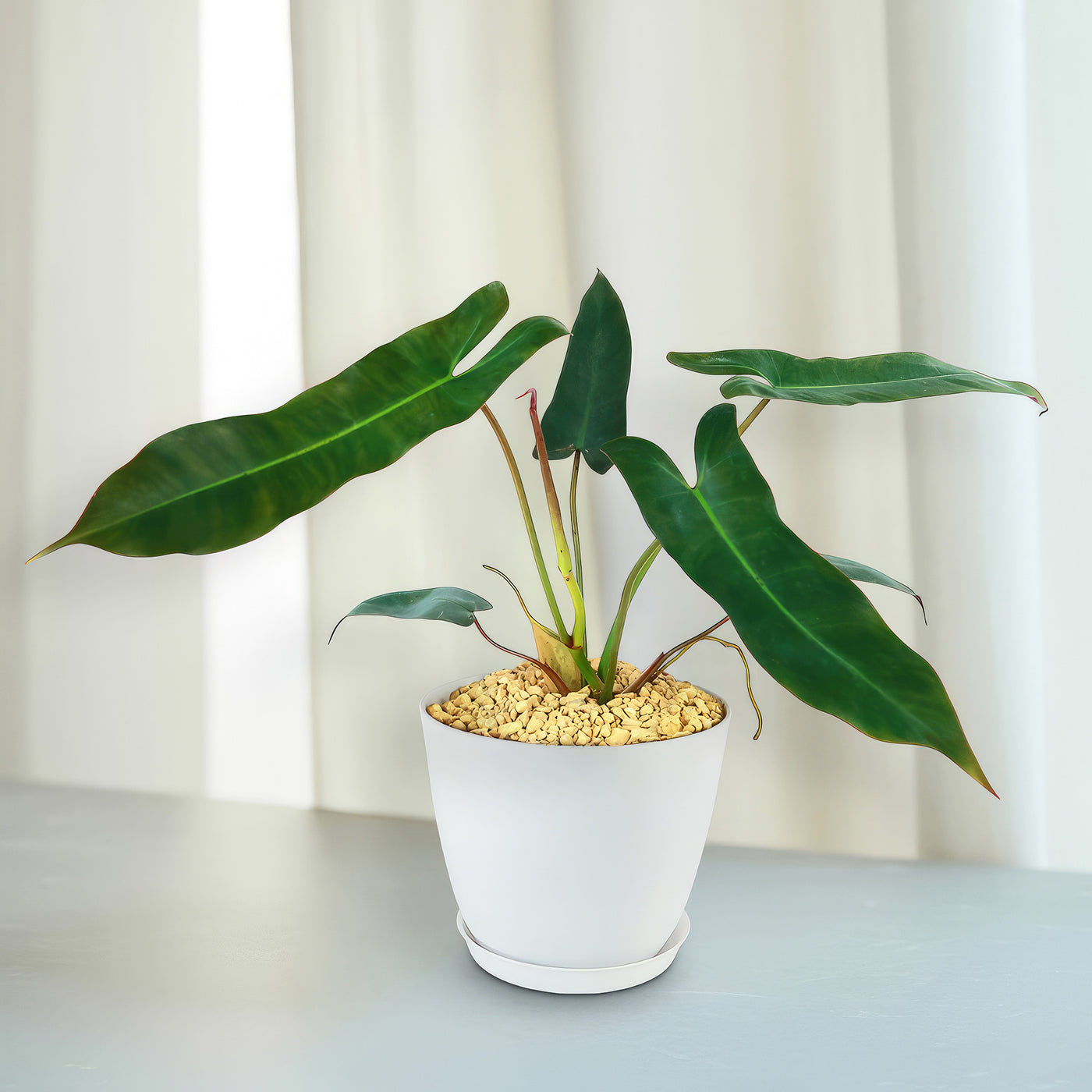
rare philodendrons for sale Philodendron atabapoense 6" Pot / Self Watering / Without Pot
SKU: 8551663298
rare philodendrons for sale

rare philodendrons for sale Philodendron atabapoense 6" Pot / Self Watering / Without Pot

Sale price$25.51 Regular price$28.34
Save 10%

Pay in installments of $7.08 with ShopPay, AfterPay and Klarna

Shipping Estimate
USA
  • USA
  • CAN

Ships within 48 hours · Estimated delivery Jul 1 - Jul 6

Promo Codes Available:

For Your Every Summer RSVP, with Code: SUMMER15

Description

rare philodendrons for sale Philodendron atabapoense 6" Pot / Self Watering / Without PotKey Highlights Philodendron atabapoense The Philodendron atabapoense is highly sought after as a houseplant due to its fast growing, climbing nature and adaptability to indoor conditions. While it thrives in humidity, this plant is surprisingly resilient and can tolerate short dry periods if necessary. Its long, narrow leaves feature deep green tops and striking maroon purple undersides, giving it an exotic appearance. It is a hemi epiphytic plant

Key Highlights - Philodendron atabapoense 

  1. The Philodendron atabapoense is highly sought after as a houseplant due to its fast-growing, climbing nature and adaptability to indoor conditions.
  2. While it thrives in humidity, this plant is surprisingly resilient and can tolerate short dry periods if necessary.
  3. Its long, narrow leaves feature deep green tops and striking maroon-purple undersides, giving it an exotic appearance.
  4. It is a hemi-epiphytic plant that climbs trees in its native habitat and benefits from a moss pole or trellis indoors to encourage larger, elongated leaves.

The Philodendron atabapoense is a striking rare climbing philodendron that has gained popularity among plant collectors due to its elongated, lance-shaped leaves with deep green tops and contrasting maroon undersides. Unlike more common philodendrons, it has a sleek, refined appearance that makes it stand out in any indoor or outdoor plant collection. 

Philodendron atabapoense grows great indoors while maintaining an impressive size, making it a favorite among houseplant enthusiasts. When given proper support, such as a moss pole or trellis, it will produce longer, more dramatic leaves, enhancing its visual impact. In the wild, it grows as an epiphyte, climbing trees and reaching for sunlight while absorbing moisture and nutrients from the humid air. 

Native to the tropical rainforests of Venezuela and Brazil, this plant has long, narrow arrow-shaped leaves with a deep green upper surface and a burgundy to maroon underside with an illustrious shine and sheen.

This color contrast gives it an exotic appearance that is highly appealing to plant collectors.

The plant is also known for its fast-growing nature, especially when provided with adequate support, humidity, and indirect light.

When grown indoors, this Philodendron typically grows up to 6 feet tall and 3 feet wide, depending on its support structure.

In its natural habitat, it can climb much higher, reaching over 10 feet. The leaves can grow significantly longer when provided with optimal conditions, adding to their appeal as a large, dramatic houseplant. 

The flowers of Philodendron atabapoense are small and greenish-white in color. Its blooms consist of a spathe and spadix, which are typical of the Araceae family. The spathe is usually green or maroon on the outside and pale inside, enclosing the spadix that contains tiny flowers. However, it rarely flowers indoors, as it requires specific environmental triggers, including high humidity and warm temperatures. 

One unique aspect of Philodendron atabapoense is its epiphytic and hemi-epiphytic nature, meaning it can grow both in soil and attached to trees. This versatility allows it to adapt well to different growing conditions. It also has a high tolerance for humidity fluctuations, making it easier to care for than some other tropical plants. Its leaves have a leathery texture, helping reduce moisture loss and allowing it to thrive in various indoor environments. 

When and How to Water Your Philodendron atabapoense 

Like other drought-tolerant plants, the Philodendron atabapoense is an excellent choice for plant enthusiasts who prefer low-maintenance greenery. This species can withstand occasional dry spells, thanks to its ability to store moisture in its roots. However, while it is resilient, it thrives best when provided with consistent moisture, allowing the soil to dry out slightly between waterings. Overwatering can lead to root rot, so a well-draining potting mix is essential to prevent standing water.

In the spring and summer, during the active growing seasons, it requires more frequent watering to support its vigorous growth. Water the plant thoroughly when the top 1-2 inches of soil becomes dry, ensuring even hydration. The frequency of watering largely depends on environmental factors such as humidity, light exposure, and pot size. If grown outdoors, the plant may require more frequent watering during hot, dry periods. 

In fall and winter, during the dormant season, your Philodendron enters a slower growth phase and requires less water. Watering should be reduced to prevent excessive moisture build-up in the soil. Ensure the soil is dry at least halfway before the next watering. Maintaining proper humidity levels indoors can help prevent dehydration, but misting is generally unnecessary unless the air is extremely dry. 

Light Requirements – Where to Place Your Philodendron 

When grown indoors as a houseplant, this plant thrives in bright, indirect light. It should be placed near a window with filtered sunlight, such as a north or east-facing window, where it can receive 6 to 8 hours of indirect light daily.

Too much direct sunlight can scorch its leaves, while insufficient light may lead to leggy growth and slower development.

Grow lights can supplement natural light if necessary, ensuring consistent growth throughout the year.

For outdoor cultivation, this Philodendron prefers dappled sunlight or partial shade, similar to its natural rainforest habitat.

It can tolerate morning sun but should be protected from harsh afternoon rays to prevent leaf damage.

If grown under a tree canopy or shaded patio, it will flourish with at least 5 to 6 hours of bright, indirect light daily. In tropical climates, it can be grown outdoors year-round with proper light exposure. 

Optimal Soil & Fertilizer Needs 

The Philodendron atabapoense favors very airy, sandy soil that drains well. Avoid using dense, compacted soils that trap excess water, leading to root rot. Instead, make or buy a well-draining potting mix, or ideally use our specialized potting mix that contains 5 natural substrates and mycorrhizae to promote the development of a strong root system that helps your Philodendron to thrive.

For optimal growth, fertilize Philodendron atabapoense once a year in their actively growing season which is typically spring using a ratio of about 5-10-5 (NPK). Organic options like fish emulsion or worm castings can also boost soil nutrition. Stop feeding in the dormant months when the plant’s growth slows. 

Hardiness Zones & More 

When grown indoors as a houseplant, it prefers temperatures between 65°F and 80°F and humidity levels above 50%. Keeping it in a warm, humid environment mimics its natural tropical habitat, promoting lush growth. Avoid placing it near cold drafts, air conditioners, or heating vents, as extreme temperature fluctuations can stress the plant.

In the United States, this is mostly an indoor plant, but if you live in southern Florida or Hawaii then you can cultivate it outdoors in USDA zones 9-11.

It prefers high humidity and bright, indirect light similar to its rainforest origin.

If growing outdoors in cooler climates, it should be brought inside when temperatures drop below 50°F to prevent cold damage. 

If you are concerned about humidity or notice browning edges on your plant leaves. This addition will dramatically improve the health of your philodendrons. 

Wildlife – Philodendron Flowers Attract the Following Friendly Pollinators 

The Philodendron atabapoense flowers are known to attract a variety of pollinators such as bees, butterflies, hummingbirds, and beetles in their natural habitat. While the plant is primarily grown for its stunning foliage, when it does flower, these pollinators help with its reproductive cycle.

Butterflies
Bees
Hummingbirds
Lady Bugs
Multi Pollinators
Other Birds

According to the ASPCA, Philodendron atabapoense is mildly toxic to humans, and pets such as cats and dogs. The plant contains calcium oxalate crystals, which can cause oral irritation, excessive drooling, and gastrointestinal discomfort if ingested in a large amount. It is safe to touch and handle, making it a popular choice for indoor houseplants.  

How to Propagate Philodendron atabapoense 

The Philodendron atabapoense can be easily propagated through stem cuttings. Select a healthy stem with at least one node and a few leaves, then cut just below the node using sterilized shears. The cutting can be rooted in water or moist sphagnum moss before transferring it to soil. Keep the propagation medium consistently moist and place it in bright, indirect light to encourage root development. 

The Bottom Line 

Overall, the Philodendron atabapoense is a remarkable climbing philodendron with elegant foliage, rapid growth, and stunning leaf contrast. Its adaptability to indoor and outdoor conditions, along with its unique maroon undersides, makes it a favorite among plant collectors. Whether grown on a moss pole or allowed to trail in a hanging basket, it adds a touch of tropical beauty to any space. With proper care, including bright indirect light, well-draining soil, and regular humidity, it will flourish and become a standout feature in any plant collection. Order your very own Philodendron atabapoense for sale today! 

Shipping Notes
  • Free Standard Shipping on $100+ Orders to the USA.
  • Except Preorder products are shipped in 48 hours.
  • Delivery to the USA:
  1. Standard Shipping : 3-10 business days
  • If time is of the essence, please consider selecting expedited delivery for faster service.
Exchange/Return Notes
  • We offer a 30-day return/exchange service after receiving.
  • Final sale items are not eligible for returns or exchanges.
  • To process your return/exchange, please contact us at [email protected]
  • Please click here for more details>>> Return & Exchange Policy
SKU: 8551663298

Discover Niche Categories That Outsell rare philodendrons for sale

Top-Converting Item to Boost Your Average Order

4.4 ★★★★★
Based on 2297 reviews
Sort
Highest Rating
Newest First
Oldest First
Product Reviews
D
Verified Purchase
Duckling
Lake Worth, US
★★★★★ 5
What is anger ?
Format: Paperback
Helpful descriptions and solutions about anger.
WAS THIS REVIEW HELPFUL?YesReportShare
Reviewed in the United States on April 11, 2025
D
Verified Purchase
Dave Jenkins
Cuba, US
★★★★★ 5
Read this book slowly, prayerfully and watch as God works in and through your life.
Format: Paperback
How People Change is written by Timothy S. Lane and Paul David Tripp. Both men are experienced Pastors, counselors and Professors. Every year tons of books come on the market that seeks to help readers grow in understanding their problems and overcoming their difficulties. On the back cover of the book Dr. Mark Dever offers this endorsement of How People Change: This book is applied theology. It is about heat, the cross, and fruit. It's about present grace. In sixteen short and well-illustrated chapters, the wonderful prospect of change for the good is held out for the reader. We are called to consider our circumstances and our responses to them, and beneath that to examine our hearts' desires and to afresh to Christ's Cross. This book will challenge you and confront you in ways that will make you uncomfortable. This is not a book of "feel good self-help" where you will learn six to ten steps to be a better person. This book begins with proclaiming the bad news that man is a sinner in need of a Savior and then proceeds to explain the remedy to sin which is found in Christ alone. Perhaps you've read a self-help book before, or you've listened to other self-help guru's on TV, and found their advice to be wanting. Drs. Lane and Tripp in How People Change lead their readers through what biblical change is by first helping the reader see their sin so they can behold the Savior who longs to change you through and through. In this book, you will learn to see how God is at work to make you the person you were created to be. In this book, you will be confronted to examine your life in light of the Bible which will be painful at times. Most importantly this book will help you grow in the Gospel. This book will help you grow through the trials we all experience by not relying on yourself but on the Gospel. This book will help you grow in effectiveness in ministry, because the message of this book is aimed to help you grow in personal holiness unto the Lord. Perhaps you have a struggling marriage- this book will help address heart issues rather than surface issues that are affecting your relationship with God and others. This book will address, confront and challenge your pride, your self-reliance, and your self-righteousness. Yet, this book never misses a beat when it discusses the bad news but also presses the reader to go lay down their burdens, cares, wants, needs, anxieties and problems at the Cross of Christ. Dr. Dever is correct in his description of this book- it will challenge you to consider your circumstances, your responses to them, and beneath that to examine your hearts desires and turn afresh to the Cross. Take up and read this book! Read this book slowly, and digest its message. Read this book prayerfully and discuss it with others. I heartily recommend this book for new and mature Christians. The authors explain the Gospel in a way that is thoroughly biblical and yet practical. The strength of this book is that it is thoroughly Gospel-centered. As I read this book, I was challenged and confronted by areas in my own life that needed to change. As I continued reading the book, and finally finished the book, I saw more clearly how God was at work in my life. The authors achieve their Gospel-goals wonderfully in this book. I can only pray (as I'm sure the authors do and many others) that many more believers take up this book, and not only read it but heed its message.
WAS THIS REVIEW HELPFUL?YesReportShare
Reviewed in the United States on January 19, 2011
J
Verified Purchase
Jesvin Jose
Lexington, US
★★★★★ 5
Highly recommended!
“How people Change” is the second best book I have read this year (the first being “The Gospel according to Jesus” by John MacArthur). There is indeed a “gospel gap” (as the authors call it) among Bible-believing Christians today. We believe the gospel for our past forgiveness and future hope, but often forget that the gospel applies to present everyday living as well. They focus our problem on heart idolatry - we have replaced Christ with something else! They put it this way – “The heart is the steering wheel of every human being. Everything we do is shaped and controlled by what our hearts desire. That is why the Bible is very clear that God wants our hearts. Only when God has your heart does he have you. As much as we are affected by our broken world and the sins of others against us, our greatest problem is the sin that resides in our hearts. That is why the message of the gospel is that God transforms our lives by transforming our hearts.” And again, “Even though life is hard, it is not the hardships that cause us to respond as we do. Our responses are shaped by the thoughts and motives of our hearts (Heb. 4:12).” The authors also remind us that in Christ and His gospel, we have a new record, a new power and are set free from the enslaving power of sin. They write, “With the new record and new power we have received, we are set free from the enslaving power of sin and the condemnation of the law. We are dead to the world and we have power over the Evil One who tempts us with worldly Christ-replacements. We don’t have to be controlled by them anymore! We are now free to live, act, think, and believe in new and surprising ways.” The authors also remind us of our marriage or union to Christ, and how God designed heart change to take place in the context of community (the church) – something we conveniently ignore in our mostly individualistic culture! The latter part of the book focuses on four themes: Heat, Thorns, Cross and Fruit. “Heat” is the pressures of everyday life and includes blessings, temptations and difficulties. “Thorns” is the ungodly response to the daily situations of life. “Cross” is the resources available in Christ to every believer. “Fruit” is the Godly response to the situation resulting from God’s work in the heart. With sharp Biblical insight and relevant everyday stories, the authors present a mirror in front of our souls, so that we see the hope & power of Christ and His gospel for everyday living. Heart change is possible! Read this book and apply its truths! I hope to do the same.
WAS THIS REVIEW HELPFUL?YesReportShare
Reviewed in the United States on September 2, 2016
J
Verified Purchase
Joshua D. Reitano
Lexington, US
★★★★★ 5
Lasting change
Format: Paperback
What does it take for lasting change to take root in your life? This is the question Timothy Lane and Paul Tripp tackle in the book. Both are biblical counselors and faculty at CCEF (Christian Counseling and Education Foundation - maybe the best biblical counseling group out there). Paul Tripp is also a pastor at Tenth Pres in Philadelphia. The authors believe that in the lives of many believers (and a whole lot of churches) there is a "gospel gap." Many Christians are ineffective and unproductive because they see the good news of the gospel as the means of cleansing their past sins, and the way to be assured of a future hope. But they forget the power of the gospel to change their life in the hear and now. Lane and Tripp use Jeremiah 17:5-10 as the source for their dominant metaphor for life change. This passage gives us a view of life that involves four elements. 1. Heat - This is the person's situation in daily life, with difficulties, blessings, and temptations. 2. Thorns - This is the person's ungodly response to the situation. It includes behavior, the heart driving the behavior, and the consequences that result. 3. Cross - This focuses on the presence of God in his redemptive glory and love. Through Christ, he brings comfort, cleansing, and the power to change. 4. Fruit - This is the person's new godly response to the situation resulting from God's power at work in the heart. It includes behavior, the heart renewed by grace, and the harvest of consequences that follow. Each chapter has large sections of careful explanation of biblical passages. Lane and Tripp also use real life examples from their counseling and church ministry to illustrate the point. It's both theological and practical. It's a great book for those who do counseling, or even just general discipleship. It's a good book for those wanting to better understand the process of sanctification, and how they themselves can grow. I'm looking forward to looking through the curriculum based on the book, and see if we can find a venue to use it in our church. Highly recommended!
WAS THIS REVIEW HELPFUL?YesReportShare
Reviewed in the United States on June 19, 2010
V
Verified Purchase
Vicky Wu
Natrona Heights, US
★★★★★ 4
Helpful but could be a little shorter
Format: Kindle
Disclaimer: I’ve read the Study Guide version and completed the Biblical Counseling training by City-to-City which went through the model prior to reading this book. Personally I think this could be a very helpful introduction to people who are new to the model of biblical change. The book is full of explanations and examples which make the model practical. However, I found the book a little too repetitive, and I felt like it could be a lot shorter than it is now. Any how, this book provides a very practical model that could benefit your ministry and help you in your personal growth. If you’re looking for something to go through with your small group, I actually recommend going straight forward to the Study Guide which sufficiently provides all the descriptions and examples needed.
WAS THIS REVIEW HELPFUL?YesReportShare
Reviewed in the United States on July 25, 2020

recommand products